
Santa Clara City Directory Runs
The central Santa Clara city directory collection is held by the San José Public Library California Room. Its San José and vicinity volumes run from 1870 through 1979 in print and from 1870 through 1960 on microfilm. Earlier books include Santa Clara and other county communities. Full Santa Clara volumes are digitized for 1870, 1887, and 1920, with business sections available for 1870 through 1918. Missing issues are real, so a target year must be checked with staff.
| Collection | Years | Where held | Access |
|---|---|---|---|
| San José and vicinity city directories | 1870-1979 print; 1870-1960 microfilm | SJPL California Room (Santa Clara entries) | In person; selected digital volumes |
| Santa Clara criss-cross issues | 1915-1919; 1922-1937 verified | California Room and History San José (Santa Clara issues) | Matrix and in-person research |
| Telephone books | 1905-2018 | History San José | Research library |
| Obituary cards | 1879-1912 | History San José | Index points to paper evidence |
| Mercury News microfilm | August 1869-December 2011, with gaps | Heritage Pavilion | In-person library use |
| Great Registers | Selected 1867-1896; film 1900-1944 | California Room | In person |
The matrix also marks Bettys and McKenney editions from 1889, Pacific Telephone and Telegraph in 1908, and Polk-Husted in 1920. Santa Clara appears repeatedly from 1870 through 1908 and throughout the listed 1909 to 1937 issues. A blank Santa Clara year may mean a missing Santa Clara issue, a changed coverage line, or an address outside the publisher’s area.
Where Santa Clara Directories Are Held
The SJPL California Room directory page is the first Santa Clara shelf check. Its Santa Clara directory matrix is more precise than a broad catalog search because it records editions and missing years. History San José adds Santa Clara family files, title abstracts, block books, maps, yearbooks, school papers, and reverse telephone material. The Heritage Pavilion adds Santa Clara local newspapers, land records, early-settler files, cemetery indexes, and pre-1905 county extracts.
The captured San José Public Library city-directory shelf illustrates the local holdings used for Santa Clara research and nearby Santa Clara communities.
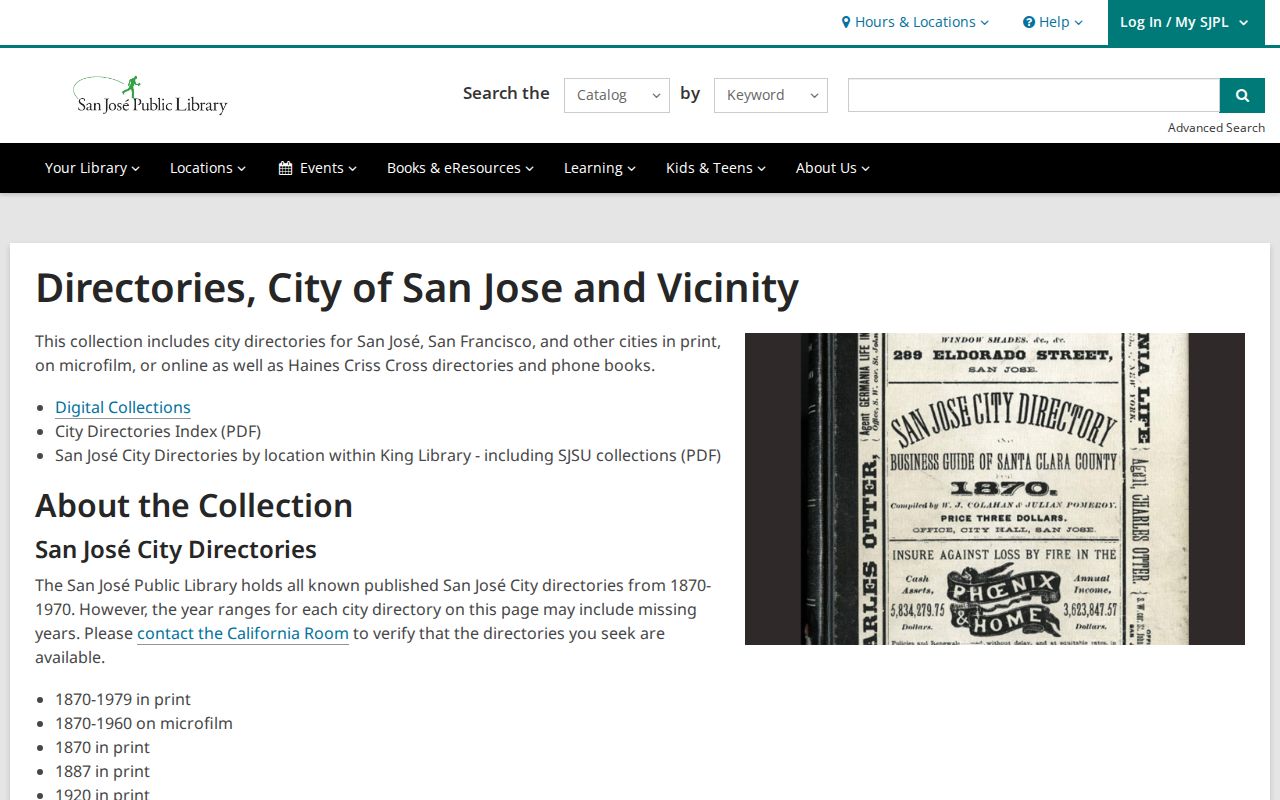
Use the image as a collection cue, then confirm the exact edition, location, and access conditions with the library before relying on a year.
The Santa Clara City Library describes its local-history formats as books, maps, photographs, posters, clippings, scrapbooks, pamphlets, oral histories, audiovisual material, and manuscript copies. Items that do not appear in the Santa Clara catalog may sit in the Genealogy Room. Licensed databases include Ancestry Library Edition for in-library use, HeritageQuest, American Ancestors, FindMyPast, and Historical San Jose Mercury.
Santa Clara directory shelves are a physical access channel, not a sign that every volume is digitized. Ask staff to confirm a year before building a long search plan.
Santa Clara City Directory Criss-Cross Years
A conventional city directory starts with a surname and points to an address. A Santa Clara city directory can add a criss-cross section that turns that around. It lets a researcher start with a Santa Clara street and see the names printed beside the address. Santa Clara’s documented reverse period begins in 1913 according to SJPL, while History San José dates it to 1914. The Santa Clara difference is worth keeping because the institutions may be describing separate sets or indexing rules.
The California Room matrix identifies Santa Clara criss-cross issues for 1915 through 1919 and 1922 through 1937. Later Haines and Pacific Bell reverse directories continue the address-first pattern after the main city-directory era ends. When a target Santa Clara address is absent, check the prior and next volume, the street suffix, and the city boundary used by that publisher.
For a modern address chain, the Santa Clara street directory route owns parcel and permit evidence. The historical volume remains the occupant layer for its publication date.
Santa Clara Directory Publishers
Publisher changes matter because the same Santa Clara town can be organized, labeled, and covered in different ways. Each Santa Clara city directory needs its title page checked. Bettys and McKenney editions appear in 1889. Pacific Telephone and Telegraph appears in 1908. Polk-Husted appears in 1920 beside a conventional Pacific Telephone edition. A publisher may include Santa Clara in a San José and vicinity book rather than issue a stand-alone Santa Clara volume.
Record the Santa Clara title page, publisher, edition, and section before copying an entry. An apparently missing household can reflect a different city boundary, a suburban volume, a business-only section, or a missing issue. The 1938 to 1966 portion of the matrix needs visual, column-by-column review, so collapsed PDF text should not be treated as a continuous run.
Reading a Santa Clara City Directory Entry
A Santa Clara city directory entry is a compact snapshot. Older entries commonly show surname, given name or initial, residence, and occupation. Some Santa Clara volumes indicate property ownership. A spouse or co-resident may appear in parentheses, and an abbreviation key explains symbols near the front. The exact pattern varies by publisher, so transcribe what is printed rather than expanding an abbreviation from memory.
| Name | Surname, given name or initial, with spouse or co-resident notes in some runs. |
|---|---|
| Address | Santa Clara house number and street, sometimes with a residence or boarding mark. |
| Occupation | The printed work description or business connection for that edition. |
| Property mark | Some older runs indicate ownership or a property relationship. |
| Abbreviation key | The volume’s symbol list, which should be checked before interpreting an entry. |
- Criss-cross directory
- An address-first section that lists names from a street or house number.
- Householder index
- A name or household reference that helps locate the main entry in a volume.
- Abbreviation key
- The publisher’s guide to marks, shortened words, and household or property symbols.
- Entry date
- The publication snapshot, which may have been compiled months before the book appeared.
Never treat a Santa Clara entry as a current record. It can establish that a name and address appeared together in a particular volume, then needs a second source for identity.
Santa Clara Digital History Shelf
Digitized materials add reach but do not remove the need for the physical Santa Clara collection. Santa Clara University Archives and Special Collections provides digitized student newspapers, yearbooks, course catalogs, Mission manuscripts, plans, surveys, plot maps, landscape drawings, university records, family papers, and photographs. The holdings extend Santa Clara university records back to 1851 and Mission material to the earlier sacramental era.
The SCU Archives and Special Collections asks Santa Clara researchers to contact the department about two business days ahead. It lists 408-554-5530 and SpecialCollections@scu.edu. That route can place a directory entry beside a Santa Clara yearbook, student paper, or map without pretending that the two sources prove the same fact.
The SCU Archives and Special Collections page captured for the Santa Clara directory research looks like this.
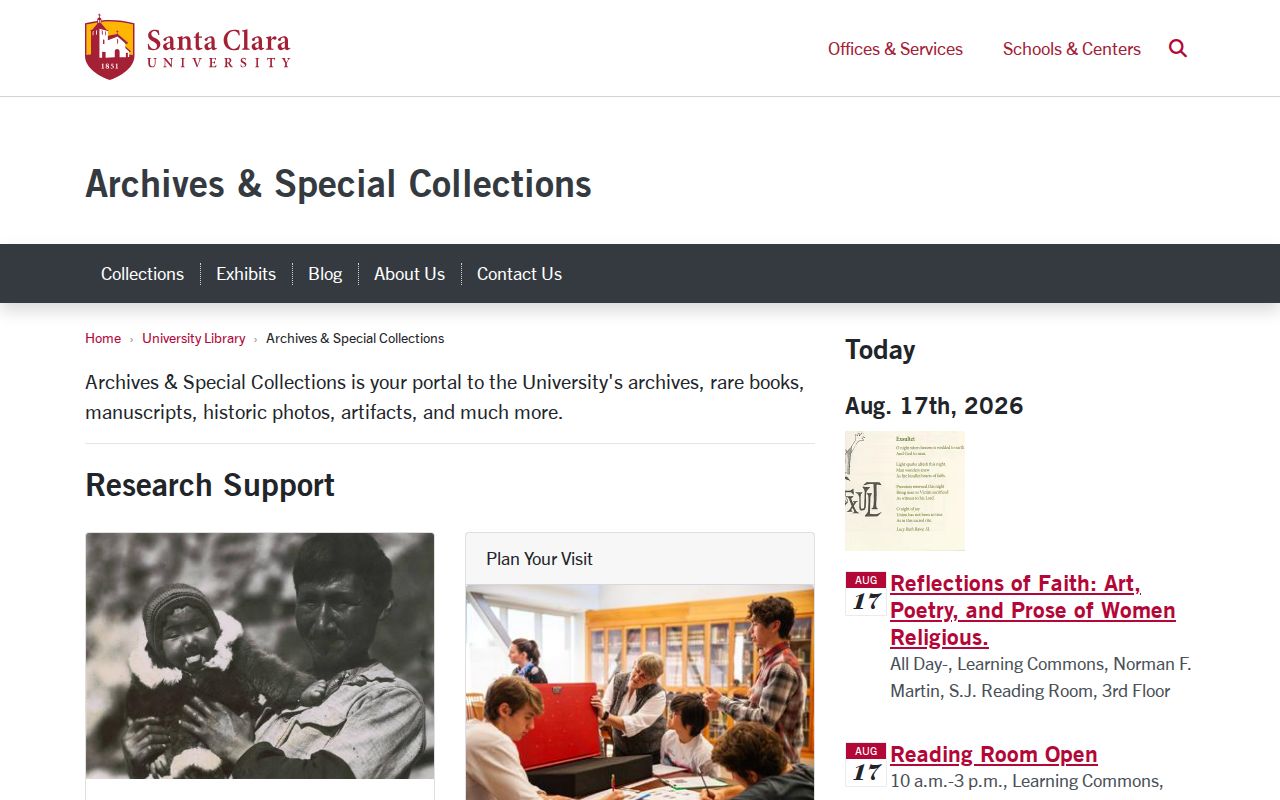
Use the Santa Clara digital shelf for discovery, then ask the archive about access, reproduction, and the precise collection title.
Santa Clara Archives Grant Story
Santa Clara County Archives began operations in April 2006 after Santa Clara County adopted a formal Archives policy in September 2004. A 2007 National Historical Publications and Records Commission grant of $200,000 targeted the processing of 1,500 cubic feet and the creation of public indexes.
The Santa Clara databases now point researchers toward planning photographs, map books, coroner inquests, naturalizations, wills and probate, militia enrollment, oaths, surveys, and dentist or doctor registers. The underlying files are generally not online, so an index result leads to an archivist, appointment, or permitted photograph rather than an instant certified copy.
Trace a Santa Clara Household Across Years
A Santa Clara family-history search should treat every directory year as one dated frame. A Santa Clara city directory search begins with the clearest name and address. Copy the entry exactly, including initials, spouse notes, occupation line, and street form. Then compare the next available Santa Clara volume rather than assuming annual publication or uninterrupted coverage.
- Find the first Santa Clara entry and photograph the Santa Clara title page and abbreviation key.
- Follow the name forward, recording every address, spouse, co-resident, and printed role.
- Flip to the criss-cross section when the volume supports address-first work.
- Pair directory snapshots with the public census years and compare ages, birthplace, household members, and tenure.
- Use obituary cards, cemetery indexes, probate, or a later deed when a person disappears.
A Santa Clara disappearance can mean a move, death, an omitted issue, a city-boundary change, or a spelling variation. A two-source match is stronger than a familiar surname. The public court portal, vital-record custodian, or California historical shelf can confirm the next step, but the entry alone should not be stretched beyond its date.
Santa Clara Directory Timeline
The Santa Clara directory story is easier to read as a Santa Clara sequence of changes. Printed volumes and later reverse books serve different needs, while the library and archive holdings preserve different kinds of names.
- 1870: the San José and vicinity directory run begins in the California Room holdings.
- 1887 and 1920: full volumes are among the digitized examples, with 1920 showing distinct publisher editions.
- 1913 or 1914: the institutions place the beginning of reverse street access in different years.
- 1915-1919 and 1922-1937: Santa Clara criss-cross issues are identified in the matrix.
- 1979: the listed printed city-directory span ends, while later telephone and reverse sources continue.
This timeline is a research aid, not a claim that every year is present. Missing issues and different publisher coverage must be checked at the shelf.
Santa Clara School and Mission Sources
Santa Clara directories become more useful when paired with sources that record a different part of life. SCU yearbooks and student newspapers can identify named students, activities, and affiliations. Mission sacramental records document Indigenous and Californio people from 1777 through 1850 and should be read in their historical context. Preserve names and relationships exactly as the record gives them.
The Heritage Pavilion and Santa Clara County Historical and Genealogical Society add Early Settler Files, pre-1905 vital and land extracts, cemetery headstone indexes, consultants, and small-fee research. Chamber scrapbooks from 1937 through 1961, Peterson High School material from 1964 through 1981, and Woman’s Club volumes from 1966 through 1971 provide named Santa Clara context that a formal directory may omit.
The Santa Clara County Historical and Genealogical Society is a companion Santa Clara repository, not a replacement for the Santa Clara directory volume.
Santa Clara Directory Work and Local Change
Directory occupations reflect Santa Clara’s changing record landscape. Tannery, seed, wood-product, fruit, and cannery firms appear in the older town story, followed by semiconductor growth after the 1950s. A Santa Clara name attached to one of those businesses is a clue to a community or address, not a shortcut to personal identity.
The Old Quad, orchard subdivisions, Northside, and Rivermark can produce different Santa Clara evidence eras. A parcel north of US-101 may first appear in a later directory, permit, or map series than a downtown address. Sanborn maps, university plans, city property histories, and the local newspaper chain can help explain that gap.
For a living person who needs record verification rather than historical context, use the Santa Clara resident lookup path and keep the directory as one dated source among several.